
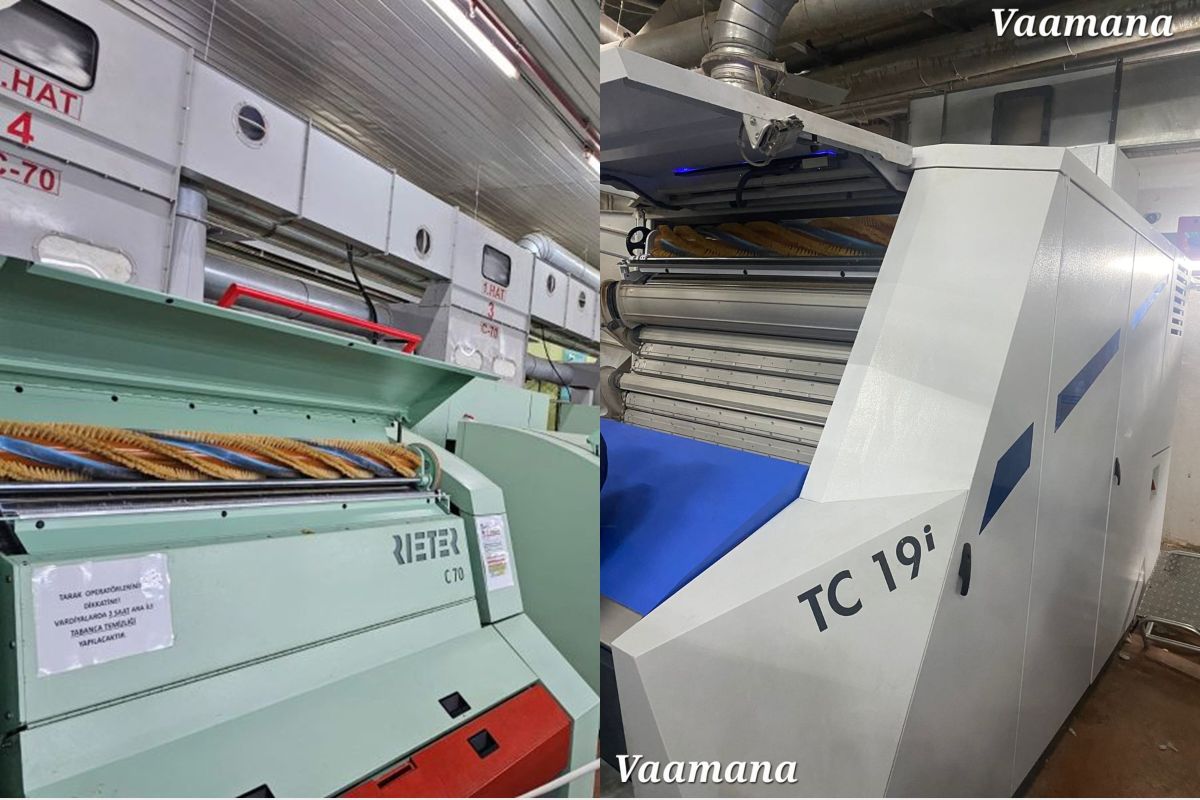
What we supply
- Card flat cleaning system (tops cleaning system) built model-wise for the card
- What it is designed to remove: embedded microdust, seed coat, short fibre, husk, and TiO2 deposition in polyester and blended fibre processing
- Replacement cleaning fillets and brushes for installed systems
- Installation, penetration setting and commissioning on the card
Application area
Cotton with high trash or microdust content, regenerated fibre, and frequent mix changes — anywhere foundation loading builds between manual cleaning cycles. Polyester and blends are a distinct application: TiO2 deposition is harder and more adherent than cotton microdust, loads the flats faster than most mills expect, and responds poorly to compressed air. The cleaning principle combines two actions: a slow-running spiral brush that penetrates the foundation and lifts deposits, and a cleaning fillet that provides a controlled fallback action for harder accumulation — designed and set so that flat wire points are not disturbed. Drive is taken from the cylinder, so power consumption is negligible and there is no separate motor.
Machine compatibility
Fitted model-wise. Current installed coverage includes Rieter C-series, Trützschler TC-series and LMW cards; Marzoli, Crosrol and other card models are assessed from mounting, drive take-off and dimensional details before commitment.
What Vaamana checks before supply
- Card model fit — mounting, drive take-off and clearances confirmed per model
- Brush penetration setting against the foundation, verified at installation — deep enough to clean, never touching wire points
- Brush and fillet media matched to the deposit type (cotton microdust vs TiO2 in blends)
- Build quality: seasoned wood body and laser-cut components
- Fillet condition and correct fallback action
Information required from the mill
- Card make and model, and number of cards
- Raw material mix — cotton, polyester, blends — and observed foundation loading
- Current cleaning practice (compressed air, manual stripping, none) and its frequency
- Photos of the flat return zone if a non-standard arrangement exists
Common failure symptoms
Mills usually reach this page while investigating one of the following. If any of these match, mention it in your enquiry — it changes what we check first.
- Microdust or a grey-white deposit (TiO2 in blends) visibly embedded in the tops foundation
- Flat tops life shorter than expected for the wire specification
- Nep or quality drift between manual cleaning cycles, recovering briefly after each clean
- Compressed air being used routinely around the flats
- Rising manual cleaning effort or stripping frequency to hold the same quality
Benefits
- Consistent flat cleanliness through the shift, not only after cleaning stops
- Reduced compressed-air use and the fly/fluff it spreads around the department
- Reduced manual stripping effort and labour dependency
- More consistent working surface to the carding zone — steadier quality
- Less stress on existing cleaning media and longer flat tops life
Limitations
- It is a cleanliness system, not a repair — worn or damaged flat tops still need grinding or reclothing
- Penetration must be set at installation per card; it is not a bolt-on that self-adjusts
- Fillets are wear items and need periodic replacement
- Fitting is model-specific — dimensional confirmation is required before supply
Frequently asked questions
Why not simply clean the flats with compressed air?
Compressed air shifts microdust around the card and department instead of removing it, adds labour dependency, and moisture-laden air can corrode or damage needles. It is also largely ineffective against adherent TiO2 deposits in polyester and blends. A continuously running brush-and-fillet system removes the accumulation at source without these side effects.
Does the brush damage the flat wire points?
Not when the system is designed and set correctly. The brush is specified to penetrate the foundation area between the points, and penetration depth is set and verified at installation. This is one reason fitting is done model-wise rather than supplied as a universal attachment.
Is it useful for polyester and blended fibre processing?
Yes — arguably more than for cotton. TiO2 deposition from polyester loads the flat foundation steadily and is difficult to remove by air or light manual cleaning. Continuous brush action prevents the build-up rather than fighting it after it has hardened.
What maintenance does the system itself need?
Very little — the fillets are the normal wear items and are replaced as they wear. The drive is taken from the cylinder at slow speed, so there is no separate motor to maintain.
Related products and reading
Send an enquiry
Share your machine make and model, the component position, and the current problem if the enquiry is problem-driven. Specification is confirmed before quoting — that is the point of working with Vaamana.
Request a Technical Quote WhatsApp: +91 70104 83377 sss@vaamanacorp.com vaamanac@gmail.com
Vaamana Corporation is an independent supplier and service provider. Machine brand names are used only to identify compatibility, application or customer enquiry context. Vaamana is not affiliated with or endorsed by the respective OEMs unless expressly stated.