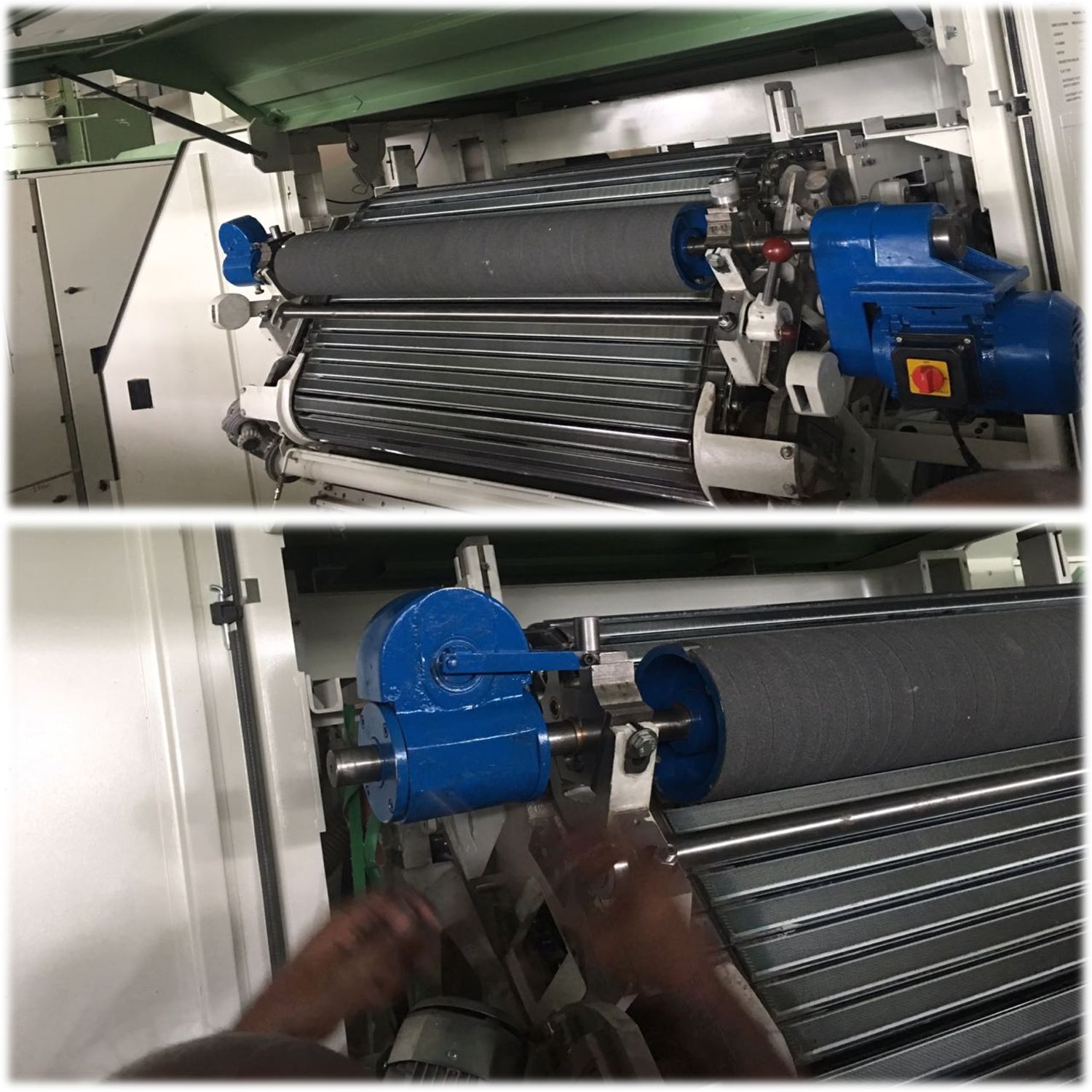
Grinding is essential maintenance. But when grinding becomes frequent, it can quietly change from a corrective action into a masking action. The machine appears to recover—yet the underlying reason for deterioration remains untouched.
Many mills fall into a cycle: performance drifts, grinding brings temporary relief, and then drift returns sooner than expected. Over time, grinding frequency increases, while stability margin continues to shrink.
Grinding Restores Sharpness, Not System Balance
Grinding can restore wire sharpness and improve immediate fibre engagement. That is real, and it matters. But sharpness alone does not guarantee stable carding.
Carding behaviour is governed by system balance: presentation, controlled separation, transfer behaviour, and waste handling. If the system is drifting for reasons beyond sharpness, grinding improves symptoms without correcting the cause.
Why the Recovery Feels Convincing
After grinding, the card often improves quickly. Waste looks better. Web looks cleaner. Neps reduce. This creates confidence that the problem was “just clothing.”
But if the true issue is a stability loss elsewhere in the system, the improvement will not hold. The card returns to drift—often sooner than before.
The “Shortening Interval” Signal
One of the strongest signals that grinding is masking a deeper issue is this: the time between required interventions keeps reducing.
When a card that previously held stable for a reasonable period starts demanding grinding sooner and sooner, it is often a tolerance problem, not a sharpness problem.
Why This Becomes a Trap
Frequent grinding creates three traps:
- False closure: the problem seems solved, so deeper investigation stops
- New baseline: the mill adjusts expectations and accepts higher intervention as normal
- Lost diagnosis time: behavioural drift signals are erased before they can be studied
Over time, the mill becomes skilled at recovery—but not at prevention.
What to Observe Before Grinding
When a mill is trending toward frequent grinding, it helps to observe behaviour before intervention. Not to delay maintenance, but to understand what is being compensated.
Useful questions include:
- What changed first: waste behaviour, web formation, or neps?
- Is the drift gradual or triggered by minor variations?
- Is the card becoming more sensitive to normal operating conditions?
These observations reveal whether grinding is correcting wear or covering a deeper instability.
A Better Interpretation
Grinding should be seen as a stabilising tool—unless it becomes frequent. When it becomes frequent, it should be interpreted as a diagnostic signal: the system’s tolerance is being maintained artificially.
Setting Grinding Intervals from Evidence
The alternative to calendar grinding is not "grind less". It is grinding on evidence, with the interval emerging from data the mill already has:
- Nep trend, not nep level. A stable-but-higher nep level after a mix change is not a grinding trigger; a rising trend at constant conditions is.
- Web inspection at the doffer. Cloudiness or streaks that persist after cleaning point toward tip condition; localised faults usually do not.
- Flat tip condition under magnification, sampled at the same flats each time so wear is compared like-for-like.
- The interval itself as a signal. If acceptable quality holds for a shorter period after each grind, stop grinding and start diagnosing — the wire is telling you the problem is elsewhere.
When the evidence does call for grinding, how it is done matters as much as when. Grinding flats in position, with controlled depth and traverse, keeps the correction repeatable — the approach behind the on-card flat grinding machine. The machine does not decide the interval; the data does.
Closing Thought
Maintenance is not the enemy. Over-maintenance is not the enemy either. The risk is misunderstanding what maintenance is compensating for.
When mills treat rising grinding frequency as a stability warning—not merely a clothing issue—they regain the ability to restore system balance instead of repeatedly recovering from drift.