Executive Summary
Drawframe top rollers and their end bushes are replacement items: most mills buying them know exactly what the part does and simply need the correct one, delivered without a wrong-supply cycle. The difficulty is rarely technical — it is identification. Drawframe generations differ in roller diameter, length, end fitment and bush type, machines get modified over the years, and a part ordered by machine name alone has a real chance of arriving wrong. This note lists what to confirm and send with an enquiry so the roller and bush that arrive are the ones that fit.
Why Correct Identification Matters
A wrong top roller is not a small error. The mill loses the freight time twice, the machine either waits or runs on a worn roller meanwhile, and the supplier and mill spend the interim assigning blame. Nearly every wrong supply traces back to the same cause: the order carried less information than the part needed. Five minutes with a caliper and a phone camera at enquiry stage removes almost all of this risk.
Machine Details Required Before Quoting
- Machine make and model — and the model suffix or generation where it exists. Drawframes with similar names can differ in roller dimensions across versions.
- Roller position — front, middle or back roller of the drafting arrangement; positions on the same machine can carry different rollers.
- Any known modifications — machines converted, rebuilt or fitted with non-original top arms may no longer match the model's standard parts.
Roller Dimensions to Confirm
- Roller diameter — measured on the arbor (the metal body) and, separately, over the cot if the enquiry includes cots.
- Roller length — overall length and, where relevant, the working length between end features.
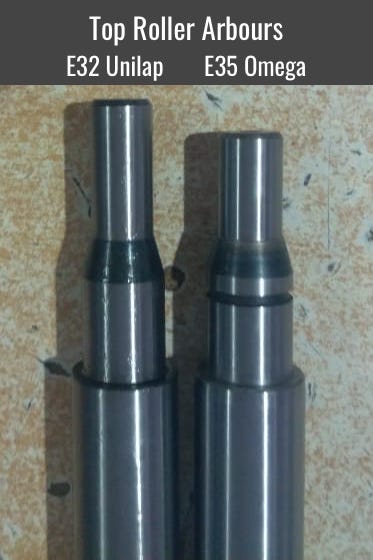
- Shaft, bore and end fitment details — the end geometry that the loading arm and bush actually engage: end diameter, bore size if the roller is bored, and the shape of the end seats.
Measure the actual part where possible, not the drawing from memory. Worn parts measure under nominal size — state the measured value and note that it is from a worn part.
End Bush Details to Confirm
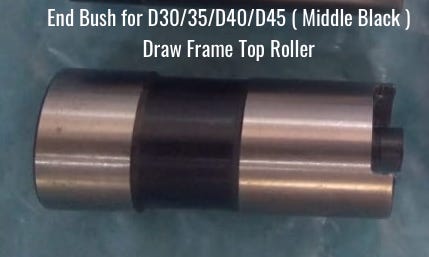
- Bush type — the bearing style the machine uses; different generations of the same maker's drawframes use different bush constructions.
- Bore and outer dimensions — the bush must fit both the roller end and its housing seat; both interfaces matter.
- Condition of the seats — a new bush fitted over a worn arbor seat runs like the old one. If the seat is visibly worn, say so with the enquiry; repair-size options may exist.
Why Photos or Samples Help Avoid Wrong Supply
A clear photo of the roller end and the bush — alongside a ruler or caliper for scale — answers questions that machine names cannot. Where a machine is old, modified or of uncertain identity, sending one worn part as a sample is the most reliable identification of all: the part is measured directly and the quotation is made against physical reality rather than a name. Samples are returned with the supply.
Common Ordering Mistakes
- Ordering by machine name only, with no dimensions — the most frequent cause of wrong supply.
- Quoting the cot diameter when the arbor diameter is needed, or the reverse.
- Assuming all roller positions on the machine take the same roller.
- Replacing the roller and reusing a worn bush (or the reverse) and expecting new-part behaviour.
- Not mentioning that the machine has been rebuilt or converted.
- Measuring one machine and ordering for ten — sister machines are not always identical, especially after years of separate maintenance.
When Roller and End Bush Should Be Checked Together
The roller and its bushes work as one assembly. If the roller ends are worn, new bushes will not run true on them; if the bushes are worn, a new roller inherits their play. As a practical rule: when either part is being replaced for wear (rather than damage), check the mating part's condition before ordering, and where the machine's history is unknown, replace them as a set. It costs little compared to a second stoppage a month later.
What Vaamana Checks Before Supply
This is a supply item, and the checks are supply checks: dimensions verified against the machine model reference or the sample provided, bush bore and outer tolerances confirmed against both interfaces, assembly runout checked where complete rollers are supplied, and freedom of rotation under hand load — no tight spots, no play. Where a sample was sent, the supplied part is compared against it directly before dispatch.
Enquiry Format for Mills
An enquiry that includes the following is usually quoted the same day, correctly:
- Machine make and model (with generation/suffix if known)
- Roller position and whether the requirement is roller, bushes, or both
- Measured roller diameter and length; end/bore details if available
- End bush type, or a photo of it
- Quantity required
- A photo of the existing part (with scale), or a sample for uncertain cases
- Whether the requirement is replacement, trial, or stock
- Delivery location
Related Products and Services
Model-wise coverage for drawframe, comber and lap-former top rollers is listed on the drawframe top rollers and end bushes page, with individual product pages for the drawframe and combing-section ranges.
FAQ
Can you supply from a sample if the machine model is unknown?
Yes — that is often the most reliable route. The sample is measured, the part is made or matched against it, and the sample is returned with the supply.
Do you supply end bushes separately?
Yes, where the roller ends are in usable condition. If the seats are worn, we will say so and discuss repair sizes rather than supply a bush that cannot run properly.
Should cots be included in the enquiry?
If the mill wants complete ready-to-run rollers, yes — state the cot size and hardness preference. If the mill re-cots in-house, bare arbors with bushes are supplied and the cot detail is only needed for dimensional reference.
How is a trial order handled?
State that it is a trial with the enquiry. A small quantity is supplied against the confirmed specification, and the order is only scaled after the mill has run them to its satisfaction.